Premium is a set of tolerances, not a price tag. A retailer's own-brand scent starts to look expensive when concentration, fill accuracy, atomiser quality, glass weight and paperwork discipline are specified together, and it starts to look cheap the moment one of them is traded away to protect the margin. Most own-brand projects that miss their positioning do not fail at the idea stage; they fail at the specification stage.
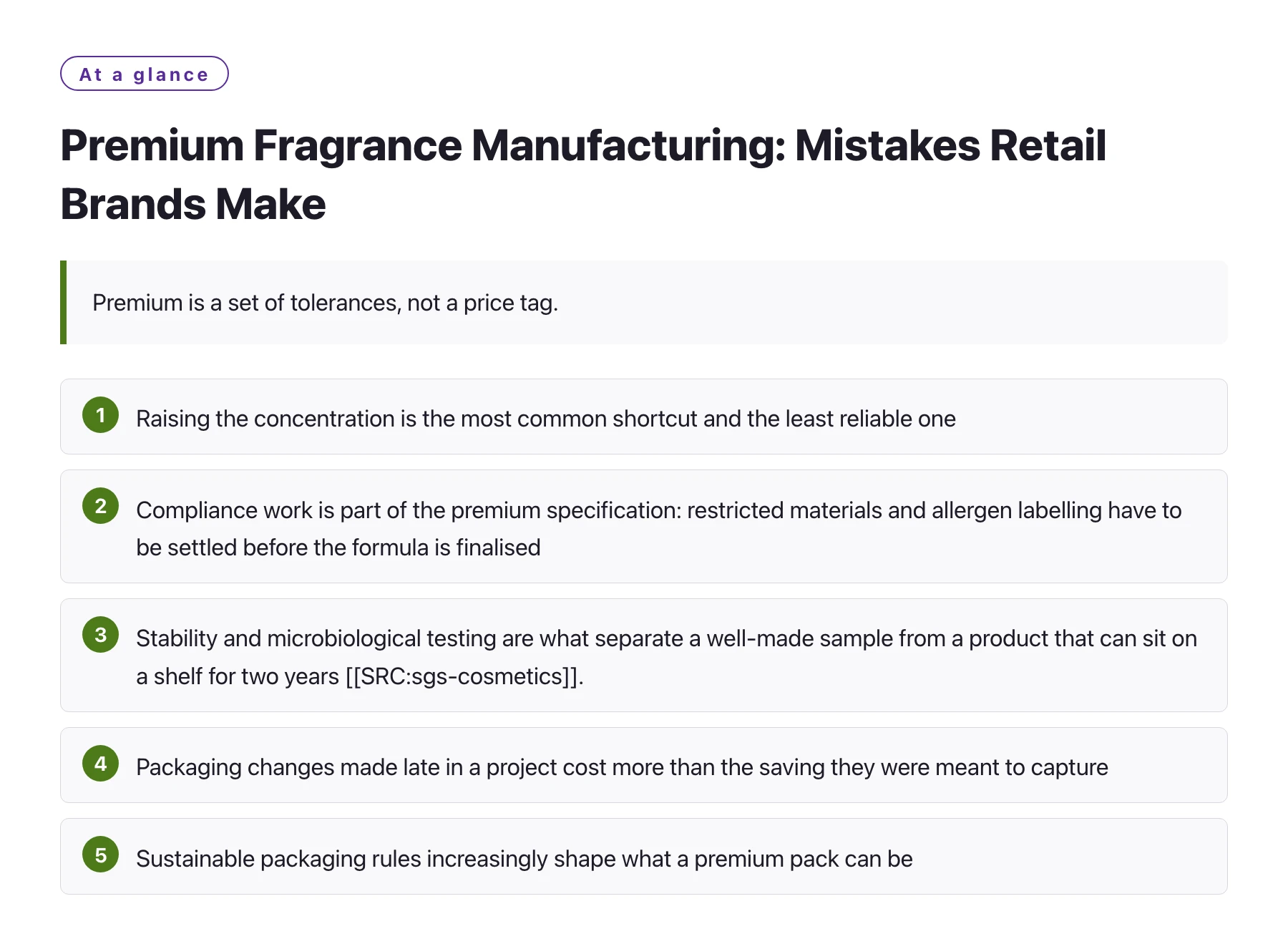
Key takeawaysRaising the concentration is the most common shortcut and the least reliable one, because a thin formula does not become rich when it is made stronger. · Compliance work is part of the premium specification: restricted materials and allergen labelling have to be settled before the formula is finalised, not after the artwork is signed off [1]. · Stability and microbiological testing are what separate a well-made sample from a product that can sit on a shelf for two years [3]. · Packaging changes made late in a project cost more than the saving they were meant to capture, because tooling and decoration sit on the critical path. · Sustainable packaging rules increasingly shape what a premium pack can be, so material choices belong in the brief rather than in a post-launch review [4].
The word premium does very little work in a manufacturing conversation. Two brands with the same target retail price can brief a factory in completely different ways, and the one that ends up feeling expensive is usually the one that specified more precisely rather than the one that spent more.
That distinction matters for retailers, because an own-brand line is judged against the brands already on the neighbouring shelf. The customer does not compare your production budget with anyone else's; they compare the weight of the bottle, the behaviour of the spray and the way the scent holds.
Below are the mistakes that repeatedly cost own-brand projects their positioning, and what to specify instead.
Why premium is a manufacturing claim before it is a marketing claim
A fragrance at a high price point is expected to behave in a particular way: the opening should be smooth rather than sharp, the drydown should last, and the spray should deliver a consistent dose. Those are production outcomes. They come from the quality of the concentrate, the accuracy of the filling line, the tolerance of the pump and the way the finished goods are stored.
None of that can be added later by better copy. This is why a retailer that wants a premium line should write the performance expectations into the brief as measurable requirements, then ask the factory how each one is verified.
That is also the standard to apply when screening a premium fragrance manufacturer: ask how each expectation is measured on the line, not only how the sample was put together.
The concentration shortcut
When a sample feels weak, the instinct is to raise the percentage of fragrance oil. It sometimes helps, but it also raises cost, can disturb the balance a perfumer built, and can push materials past the levels the industry considers acceptable in a leave-on product. The IFRA Standards Library is the reference point for those restrictions on individual ingredients [1], and a supplier who works to it will tell you when a request is heading out of bounds.
The allergen question on the label
In several markets, certain fragrance allergens have to be declared on the ingredient list above a defined concentration. EU scientific opinions underpin those thresholds [2], and a formula that is finalised before the labelling implications are checked can force a late redesign of the carton, the bottle label or both.
Seven mistakes and what they look like from the inside
| Mistake | How it shows up | What to do instead |
|---|---|---|
| Buying concentration as a proxy for quality | The formula smells louder but no better balanced | Test the concentrate at the intended dosage before adjusting anything |
| Changing the bottle to save cost late | Tooling and decoration move the launch date | Freeze the pack format before the first bulk order is quoted |
| Skipping stability and micro testing | Colour, viscosity or scent drifts in storage | Ask for a stability protocol and a test report per formula [3] |
| Ignoring labelling thresholds | Artwork has to be reprinted after approval | Check allergen declaration early with the destination market in mind |
| Choosing a pack that cannot be recycled | A sustainability claim cannot be made later | Design for recyclability from the first packaging sketch [4] |
| Approving a sample by photograph | Bulk and sample disagree at the fill stage | Retain a sealed physical reference held by both parties |
| Assuming small batches are automatically artisanal | Inconsistent fill weights and weaker QC | Ask what is inspected per batch, regardless of batch size |
Read the left column as a list of things that are cheap to decide early and expensive to decide late. That is the whole argument for specifying a premium line in more detail than a value line. The same logic applies to the quality system: a written description of quality control in luxury fragrance production is a far more useful document to read than a general assurance.
The parts of the project that carry the positioning
Three production details do more for perceived quality than anything printed on the box. The first is fill accuracy: a visible difference in liquid level between two bottles of the same product reads as carelessness. The second is the atomiser, which is the only part of the product the customer physically operates. The third is the closure, because weight and thread feel are what a hand notices before a nose does.
A factory organised to handle custom fragrance R&D and production can normally discuss all three in the same meeting, because development and filling sit with the same team. Where those steps are split across suppliers, someone has to own the interaction between them, and in most own-brand projects that someone is the retailer.
Write performance targets as tests, not adjectives
Replace lasting and elegant with statements that can be checked: a specified fill weight with a tolerance, a defined spray output, a colour standard measured against a retained sample, and a storage period after which the product is re-assessed.
Decide what happens if a target is missed
Agree in advance whether a marginal batch is reworked, re-tested or rejected, and who pays for which. Premium projects rarely fail because a problem appeared; they fail because nobody had agreed what to do when one did.
A practical rule for own-brand teams: if a saving touches anything the customer can see, smell or touch, treat it as a positioning decision rather than a cost decision, and make it in a meeting that includes the person responsible for the brand.
Sources
- IFRA Standards Library (International Fragrance Association) —— The IFRA Standards Library lists the restrictions the fragrance industry applies to individual fragrance ingredients, based on safety assessments; it is the reference point for compliant fragrance formulation.
- EU Scientific Committee on Consumer Safety (SCCS) —— The EU scientific committee that issues opinions on the safety of cosmetic ingredients, including fragrance allergens and their labelling thresholds.
- SGS: Cosmetics, Personal Care & Household Testing —— Testing, inspection and certification services for cosmetics and personal care, including microbiological, stability and safety testing aligned with cosmetics GMP.
- European Commission: Packaging Waste and the PPWR —— EU rules on packaging and packaging waste, including the Packaging and Packaging Waste Regulation requirements on recyclability and design.
Frequently asked questions
Does a premium fragrance need a higher concentration?
Not necessarily. Perceived richness comes from the composition and the quality of the materials as much as from the percentage. Choose the concentration that suits the intended use, then test at that dosage.
How early should packaging be locked?
Before the bulk order is quoted, and ideally before the formula is finalised. Bottle tooling and decoration often take longer than the fragrance itself, so a late change moves the launch date.
Is stability testing really necessary for a small first run?
Yes. Any product intended to sit on a shelf for months needs evidence that colour, viscosity and scent hold up, and that the preservative system performs under the intended packaging.
Can a retailer ask for an exclusive version of a stock accord?
Often, yes, and it is a commercial term rather than a technical one. Ask what exclusivity covers, how long it lasts and what happens to the formula if the relationship ends.
What single document reveals the most about a supplier?
A batch record from a previous run. A certificate shows that a system was audited; a batch record shows what was actually done, by whom, and what was checked before release.