Free Versus Paid Cabinet Sample Programs
A no-charge sample and a $9.99 sample that comes back with an order are not the same offer, even when both end at zero. The difference is who carries the cost while the decision is open. CasaBuilt's published terms make the sample a refundable purchase: $9.99 per door against a $19.99 list price, returned when cabinets are bought, so twelve doors cost $119.88 at checkout before any refund.

Key takeaways
- The refundable model charges $9.99 per door up front and returns it with a cabinet purchase.
- Twelve doors cost $119.88 before the refund, about 10% of the $1,199.50 White Shaker starter kitchen.
- A non-refundable fee converts the sample into a small purchase; a no-charge sample usually narrows the selection.
- The published sample list is 16 doors, so twelve covers three quarters of the range.
Three models, one question
Sample programs come in three shapes. One ships doors at no charge. One charges for the door and keeps the money. One charges and refunds the money when a kitchen is ordered. All three can produce the same door in the same box. What changes is the incentive each one creates and the information each one gives the buyer before the kitchen is committed.
The no-charge model has the smallest barrier and the widest restrictions in practice, because a seller giving away doors has to limit how many go out and to whom. The non-refundable model is honest about cost: the door is a product, priced like a product, and the buyer owns it outright. The refundable model sits between them, and it is the one that behaves most like a deposit.
The question to ask is not "which is cheapest" but "what happens if I do not buy". Under the no-charge model the answer is usually nothing, because the door was never billed. Under the non-refundable model the door stays and so does the charge. Under the refundable model the door stays and the charge stands until an order clears it.
What each model costs at checkout
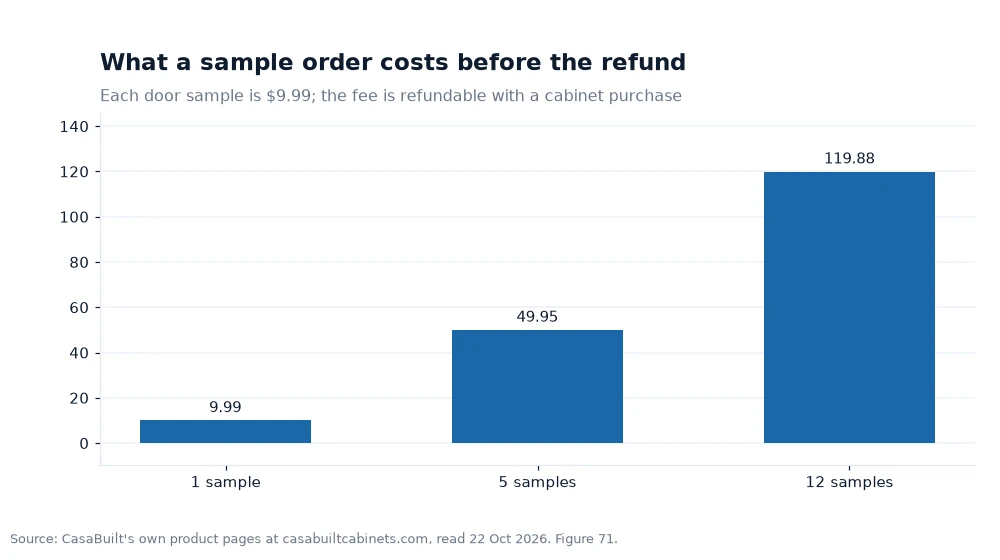
The checkout figure is the cleanest way to compare them, because it is the only number that is identical across all three before any condition applies. At $9.99 a door, one door is $9.99, five are $49.95 and twelve are $119.88. The table sets that against the refundable outcome and against the non-refundable one.
| Doors | Paid at checkout | Refunded with a cabinet purchase | If the program does not refund | At the $19.99 list price |
|---|---|---|---|---|
| 1 | $9.99 | $9.99 | $9.99 | $19.99 |
| 5 | $49.95 | $49.95 | $49.95 | $99.95 |
| 12 | $119.88 | $119.88 | $119.88 | $239.88 |
| 16 | $159.84 | $159.84 | $159.84 | $319.84 |
The third and fourth columns are identical, which is the point. The refundable model does not cost less at checkout; it costs less later, and only if the later event happens. A buyer who compares only the checkout number will conclude that all three models are the same. A buyer who compares the columns after an order will see a $119.88 difference on a twelve-door set.
The refundable model in practice
CasaBuilt's version is simple enough to state in a sentence: the published free sample is refundable with a cabinet purchase. That sentence does a lot of work. It means the buyer pays, receives a door, and gets the money back only when the kitchen is ordered. It also means the seller has no reason to restrict how many doors go out, because each one is billed.
That last effect is the practical advantage. The published range is 16 doors, and nothing in the terms caps a sample order at one or two. A buyer can compare twelve doors, which is three quarters of the range, for $119.88 up front. A no-charge program would rarely ship twelve doors to one household, because the seller absorbs $119.88 of cost with no commitment.
The refundable model also removes an awkward conversation. If the finish does not work, the buyer has not lost a deposit on a kitchen; they have bought a door at half its list price. If the finish does work, the fee returns and the sample cost is zero. The risk of sampling sits with the buyer for a few weeks and then moves back to neutral.
When paying is the better deal
A non-refundable fee is not automatically worse. It is better when the sample is the end of the transaction rather than the start. A renter matching a cabinet door for a single replacement, or a homeowner repainting one wall cabinet, may never place a kitchen order, and a refundable fee that never refunds is just a fee with extra steps.
It is also better when the buyer wants the door as a physical reference for years. A paid sample is a possession with no condition attached. The refundable door carries an implicit nudge to order, and a household that buys twelve doors and then postpones the kitchen for two years is holding $119.88 of samples with a receipt that may not survive the delay.
The decision comes down to intent. A buyer with a measured room and a budget in mind should prefer the refundable route, because the order is likely and the fee will clear. The RTA kitchen cabinet collection is where that order starts, and its style pages carry the same prices the sample was chosen against. A buyer still a year from a kitchen should prefer the cheapest door that answers the colour question, and treat the fee as the price of the answer.
Worked example: twelve doors, two outcomes
The chart values are $9.99 for one door, $49.95 for five and $119.88 for twelve. Check the multiples: $9.99 x 1 = $9.99, $9.99 x 5 = $49.95 and $9.99 x 12 = $119.88. At the $19.99 list price, twelve doors would be $19.99 x 12 = $239.88, so the sale price removes $120.00 on that basket.
Now compare the two outcomes. If the kitchen is ordered, the $119.88 returns and the sample cost is $0. If it is not, the household has twelve doors for $119.88. Set that against the $1,199.50 White Shaker starter kitchen: $119.88 / $1,199.50 = 0.0999, so the sample spend is 10% of the smallest kitchen listed. Twelve doors is also 12/16 = 75% of the published range, which is a defensible amount of the range to see before committing. Five doors is $49.95, or 4.2% of the same kitchen.
Frequently asked questions
Is a refundable sample cheaper than a no-charge sample?
Not at checkout. Both arrive at the same door, and the refundable one is billed at $9.99 first. It becomes cheaper only if cabinets are ordered, because the fee returns. A no-charge program is cheaper for a buyer who never orders, provided the program will ship the number of doors the decision needs, which is often the limiting factor.
How many doors does twelve cover in the published range?
Twelve of 16 doors is 75% of the range, which spans Shaker, Double Shaker, Slim Shaker and Frameless profiles across seven colour families. At $9.99 each the set costs $119.88 before any refund. Most households need three to five doors, so twelve is a full comparison rather than a typical order.
What happens if the cabinet order is smaller than expected?
The published condition is a cabinet purchase, not a minimum spend, so a small order still triggers the refund on the sample fee. The refund applies to the $9.99 per door that was paid, which for a five-door set is $49.95. Keep the order confirmation and the sample receipt together so the two can be matched.
Pick the model that matches your timeline
If the room is measured and the budget is set, the refundable route costs nothing in the end and buys access to the whole range. If the kitchen is a year away, buy two doors and treat the fee as the price of a decision rather than a deposit on a project. Either way, compare the models on the month after the order, not on the checkout screen.
The sample page publishes the price, the range and the refund condition. That is enough to run the comparison without a sales call, and enough to see that the cheapest-looking program is rarely the cheapest one for a household that intends to buy.
Figures quoted here come from the manufacturer's own website, read 22 Oct 2026[1].